I have been reading up on datacenter buildouts and there seems to be some sort of mass psychosis around them. There is some weird mainstream consensus that datacenters are significant water consumers, that they are the source of both air and water pollution and that they commonly affect residents with noise in their operation. This doesn’t seem to be true.
The bad
Lets start with the outliers.
X.Ai Colossus
X.Ai operates datacenters named Colossus 1 and Colossus 2. Colossus 1 was powered by temporary methane turbines with no air pollution controls, and seem to have shifted to a smaller amount of turbines with proper air pollution controls.1 Colossus 2 is powered by a larger array of permitted and pollution controlled methane turbines, and does not seem to have shifted to grid energy.2 These datacenters are located in Memphis, Tennessee, and seem to have added real pollution to a poor and historically polluted area.
Vantage DC, Sterling, Virginia
Vantage operates yet another DC powered by gas turbines. Unlike the Colossus datacenters, this one is located very close to a small neighborhood, and residents have credibly reported noise pollution (likely) from the turbines.
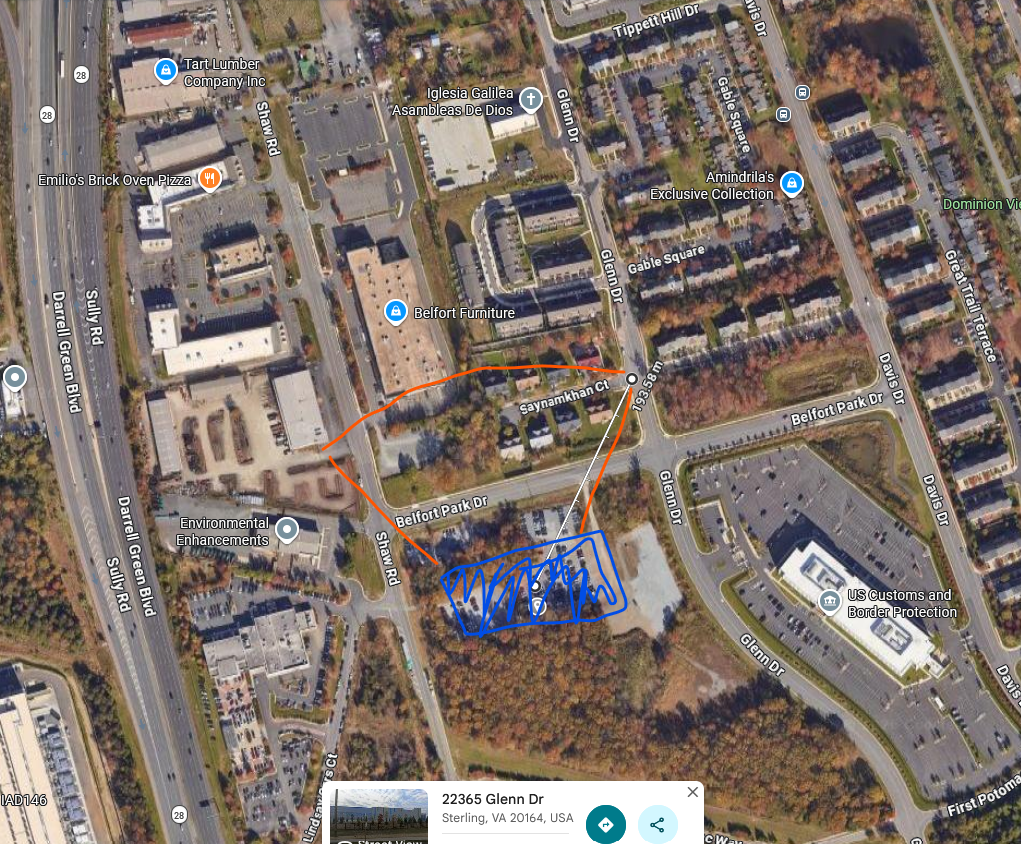
Datacenter in blue, radius of 190m in orange. This radius represents the distance at which physics predicts the noise would be above 45dB (about the noise of a quiet library) assuming 90dB at the source, centered on the building. The noise is likely to be below this level, since the turbines sit in the side of the building and are somewhat shielded.
There are about 8 houses within the affected radius, and since sound decays exponentialy, houses closer to the source likely experience much higher noise levels. It is possible that the radius is larger if the turbines are louder than 90dB after dampening, and thus would affect 30~ more residences. This seems to be a case of datacenter operation genuinely harming nearby population. There are also pollution concerns due to the turbines, but I cannot find credible sources of pollution data, I would be happy if someone could provide them.
AWS, Prince William County, Virginia
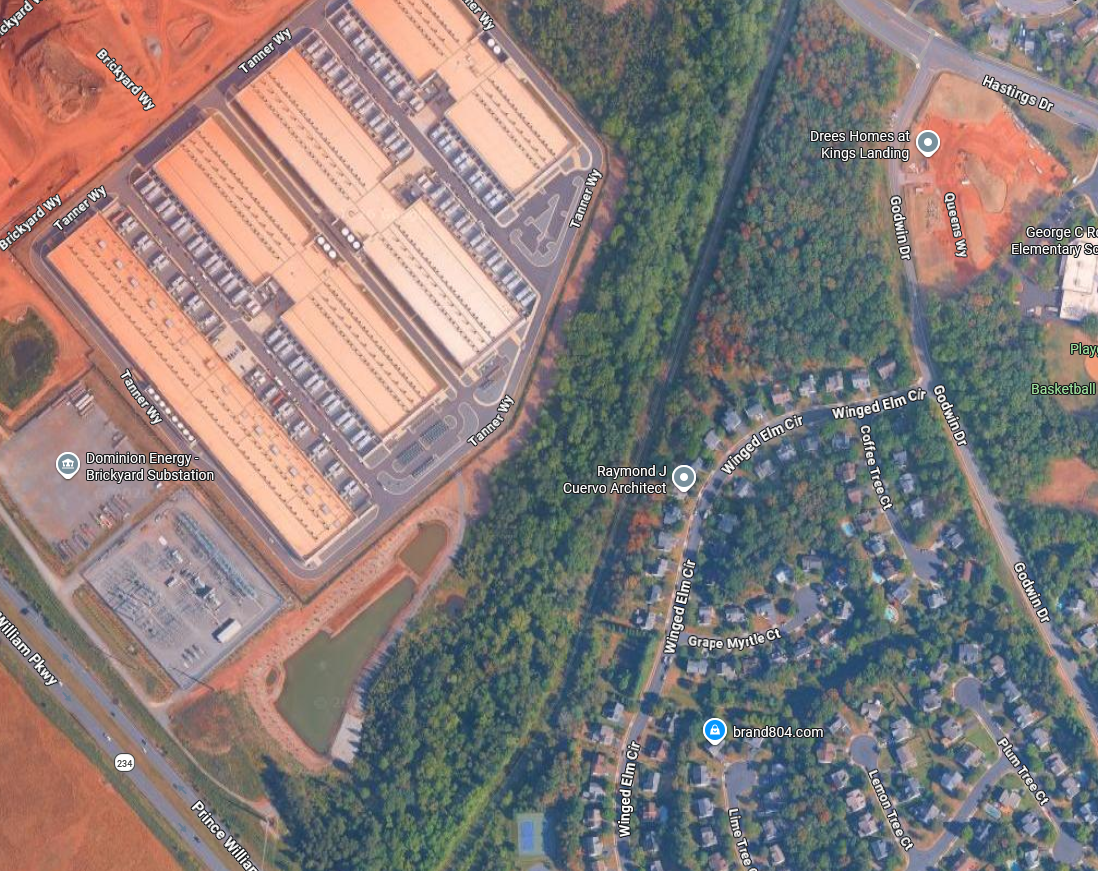
AWS operates a datacenter in Prince William County, Virginia, where measurements initially reached roughly 60–65dB at the most affected homes. This is roughly conversation-level noise, all the time~. After sustained resident and county pressure, AWS retrofitted its rooftop cooling fans, reducing the noise by roughly 10dB. County materials later reported about 54dB, although levels varied and complaints continued. This is a significant improvement, and the county is still pursuing lowering the noise levels further.
The probably misunderstood
Meta’s Georgia datacenter
There’s a pretty popular AOC clip where she says she has a dirty jar of water, from right after a datacenter was constructed, saying the only difference between the clean water and the dirty one she holds is the datacenter 3. This is not really false! But its very misleading. The datacenter does in fact not pollute the water, but the construction of the datacenter did, like any other construction project might. I’m reasonably certain you have experienced this yourself, sometimes there are road repairs and you get some dirty water, sometimes construction breaks pipes. Meta is still seems responsible for this, and thus should fix it, but we would not see opposition if this was a road construction project, or a Walmart, or a new apartment building. This is a case of construction polluting nearby water, not datacenter operation.
AWS, Louisa County, Virginia
There is a new datacenter being built in Louisa County, and there seems to be noise and some water quality concerns. The data center is not operational, once again, this is a case of construction pollution 4.
Imperial Valley Computer Manufacturing, Imperial Valley, California
A IVCM is attempting to build a datacenter in Imperial Valley, California. The company initially said they would not need external sources of water, as they were to use recycled wastewater for cooling. However, the cities providing the wastewater have now rejected the proposal, and the company is now requesting to use Colorado River water 5. The number is 287 million gallons per year (1.1 million m³), which seems like a lot, but is only 0.0284% of the Imperial Irrigation Districts 3.82 billion m³ per year water budget. This is mostly an agricultural area, and the water usage would be comparable to about a square plot of farmland with 805m sides, equivalente to about 0.032% of the agricultural area in Imperial Valley. The backlash seems wildly disproportionate to the real impact of the hypothetical DC water usage.
Reuters, “Pollution from Musk’s unpermitted xAI power project hits hardest in Black communities” ↩︎
29 News, “Louisa Homeowners Lawsuit Over Amazon Data Center Moves Forward in Federal Court” ↩︎
Economic Times, “California’s biggest planned AI data center promised not to use Colorado River water, now it wants 260 million gallons a year” ↩︎